

Falling estrogen is a hidden driver of menopause weight gain, and of the hunger and cravings that make it harder to manage. Here's how Calocurb, a natural GLP‑1 activator, helps curb appetite and support fat loss, and why the way Amarasate® (the key ingredient) is extracted keeps it free of the estrogen-active compounds found in other hop extracts.
Why Does Menopause Cause Weight Gain?
Menopause-related weight gain is driven mainly by declining estrogen combined with age-related metabolic changes. As estradiol falls, appetite regulation, satiety signaling, and fat distribution all shift — fat increasingly collects around the abdomen as visceral fat, while lean muscle mass and resting energy expenditure decline. Together, these changes make it easier to gain weight, especially around the middle, even without eating more or moving less.
Estradiol, the main form of estrogen during the reproductive years, plays a direct role in appetite and satiety: research suggests it reduces food intake and enhances fullness through the brain's appetite-control pathways.1 As estradiol declines, that natural brake on hunger weakens, contributing to changes in hunger, fullness, and overall energy intake.
These shifts begin in perimenopause, when estrogen fluctuates, and continue after menopause, when it stays consistently lower. They also drive common symptoms like hot flashes and night sweats, which affect about 80% of women and last 7 to 9 years on average — more than 10 years for roughly one in three. But midlife weight gain is never down to one factor: it reflects the combined effects of hormonal change, shifting fat distribution, muscle loss, aging, sleep, and activity levels.
The good news is that several of these levers- appetite, satiety signaling, and metabolism can be supported without hormone therapy, as the sections below explain.
GLP‑1 and Menopause: The Missing Link in Appetite Control
You've probably heard of GLP‑1 — the gut hormone targeted by medications such as Wegovy®/Ozempic® and Zepbound®/Mounjaro®. GLP‑1 (glucagon-like peptide-1) is one of the body's own satiety signals: released after eating, it helps slow gastric emptying and acts on appetite-regulating pathways that promote fullness.
Estrogen and GLP‑1 influence some of the same pathways, and research suggests estradiol and GLP‑1 may have complementary effects on appetite and body-weight regulation2 — though a direct estrogen–GLP‑1 synergy in humans hasn't been established. What is clearer is that declining estradiol contributes to changes in appetite and body-weight regulation, while GLP‑1 remains a core part of the body's normal satiety system. One non-hormonal approach is therefore to support the release of the body's own gut satiety hormones, rather than replace estrogen or directly activate GLP‑1 receptors with a medication. For a fuller comparison, see natural vs. injectable GLP‑1 approaches to appetite and weight control.
Can Hops Help With Menopause? Phytoestrogens and 8-PN
Phytoestrogens are plant-based compounds that mimic the action of estrogen. The main sources of phytoestrogens are soy, red clover, flaxseed, and hops. Hops contain one of the most potent phytoestrogens known to date: 8-prenylnaringenin (8-PN). Due to the strong estrogen-like effects, 8-PN is usually proposed as an alternative to hormone replacement therapy (HRT).
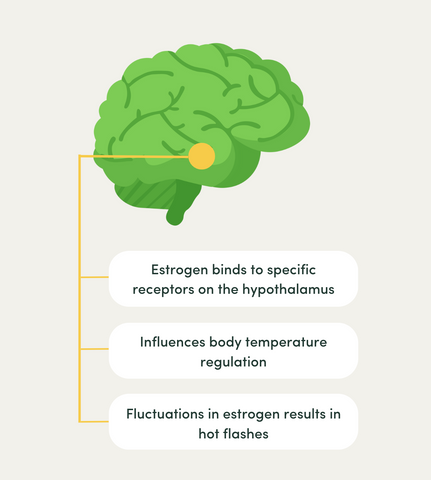
Some research has indeed found that a daily dose of hop extract, primarily formulated with 8-PN, can decrease hot flashes and increase the quality of life of menopausal women.4 The hypothalamus, the part of the brain that regulates body temperature, has estrogen receptors and is affected by the fluctuations of this hormone during menopause, resulting in abnormal sudden increases in body temperature and associated hot flushes.
That's the paradox of hops for menopause: the very estrogen-like activity that makes 8-PN useful for hot flashes is what raises the safety questions we cover next. The hops-phytoestrogen story has two sides — and it comes from a different part of the hop than the one Calocurb relies on for appetite.
Potential Risks of 8-PN
Here is where the science gets tricky. While 8-PN is one of the most potent phytoestrogens, the receptor to which 8-PN binds to provide relief from menopausal symptoms is the same receptor that may be involved in some types of hormone receptor-positive breast cancers.
This is because while other plant phytoestrogens such as soy bind to estrogen-receptor β found in fat tissue, brain, and the kidneys, 8-PN binds to estrogen-receptor-α (ERα), which is the main receptor present in the reproductive system (uterus and ovaries), bones, and breast tissue.56 The estrogen-like activity of 8-PN at this receptor is what makes it potent — and what raises its safety profile.7
Endogenous (made in the body) estrogens can be stimulators of the growth of estrogen-receptor-positive tumors and also pose a hazard to patients who have ER-positive tumors and who are being treated with antiestrogens. These findings suggest that consumption of phytoestrogens, especially 8-PN, may not be appropriate for patients at increased risk of hormone-dependent cancers or survivors.891011121314 Taken together, women who have had breast cancer, or who are at high risk for it, are advised to avoid hops that contain 8-PN without checking with their healthcare provider.
How Calocurb Supports Weight Health During Menopause
How Amarasate Works
Amarasate, the bitter hop extract in Calocurb, activates bitter taste receptors on gut cells that release the body's own satiety hormones — GLP‑1, CCK, and PYY. Rather than binding to GLP‑1 receptors the way GLP‑1 receptor agonist medications do, it works upstream, prompting the gut to release more of the fullness hormones it already produces. Human research has confirmed both effects: higher post-meal levels of these hormones and reduced energy intake.15
What the Clinical Research Shows
Amarasate has been evaluated in four peer-reviewed human clinical trials.
In a randomized crossover study of healthy-weight men, Amarasate increased post-meal GLP‑1, CCK, and PYY responses and reduced total energy intake at subsequent meals by approximately 18% versus placebo.18 Two 24-hour fasting studies then showed significant appetite reductions during the fast — in men, hunger dropped by 30%16 and, in a later crossover in healthy adult women, a 40% reduction in food cravings.17
The fourth study — a 24-week, randomized, double-blind, placebo-controlled trial of 150 overweight and obese adults aged 18 to 45 (with a BMI of 25 to 35) — found that participants taking Amarasate alongside the same diet and exercise guidance as the placebo group lost an average of 8.4 pounds (3.8 kg) versus 0.9 pounds (0.4 kg) on placebo, with significantly greater reductions in estimated fat mass and visceral fat area and no loss of BIA-estimated skeletal muscle mass in either group.19 Explore the full results in the 24-week Amarasate clinical trial.
This wasn't a menopause-specific study; participants were 18 to 45, so it isn't direct evidence for Amarasate in menopausal women. It does, however, provide longer-term evidence that Amarasate can support appetite and body-weight management, with greater fat-mass and visceral-fat reductions than placebo.
Calocurb: A Safe Alternative
Calocurb contains no traces of phytoestrogens, 8-PN, or isoxanthohumol, which can convert to 8-PN in the body. Supercritical CO2 extraction does not extract prenylflavonoids (8-PN, 6-N, xanthohumol, or iso-xanthohumol) from hops. This process delivers a natural hop extract that contains optimal concentrations of alpha acids and no trace of any other residual parts of hops.
Here's what sets Calocurb apart for menopause: while hop supplements studied for hot flashes rely on 8-PN's estrogen activity, Calocurb's alpha acids work through the gut. Because the extraction leaves out the estrogen-active prenylflavonoids, Calocurb supports appetite and weight without acting on estrogen receptors — the whole point for women who want GLP‑1-style support without adding estrogen activity to the body.
If you're navigating appetite or weight changes during perimenopause or menopause and want a non-hormonal approach, Calocurb, our natural GLP‑1 activator, is a clinically studied supplement designed to support the body's own satiety-hormone response.
Natural GLP‑1 Support
Appetite support without estrogen activity
Calocurb's supercritical CO2 extraction delivers bitter hop alpha acids with negligible phytoestrogen content — clinically studied to support satiety hormones and fat loss.


